At Baxter College, we believe that learning extends beyond the classroom walls and home learning plays a vital role in your child's educational journey. It's not just about completing tasks; it's a powerful tool we use to support our pupils in becoming independent, confident, and successful learners.
Why Home Learning Matters
Home learning is assigned for several important reasons, all designed to enhance your child's understanding and development:
-
Reinforcing and solidifying learning: Homework provides a crucial opportunity for your child to revisit and practise what they've learned in class. This extra engagement helps to solidify their understanding of concepts, making it less likely they'll forget important information. It also helps us identify any areas where your child might need a little extra support or clarification.
-
Developing independent learning skills: One of the most significant benefits of home learning is the way it fosters independence. When your child tackles assignments at home, they learn to manage their time, organise their resources, and take responsibility for their own learning. These are essential skills that will serve them well throughout their academic careers and beyond.
-
Extending and applying knowledge: home learning is about deepening understanding. It allows students to explore topics in more detail, apply their knowledge to new situations, and integrate different skills like research, writing, and problem-solving.
-
Strengthening the school-home connection: home learning provides you, as parents, with a window into what your child is learning in school. It creates opportunities for you to support their education, reinforce good study habits, and engage in valuable conversations about their progress. We truly value your partnership in your child's learning journey.
Key Stage 3
Homelearning is a vital extension of the classroom. When used correctly, it helps to cement core knowledge and builds the independent study skills students need for future success. We want to ensure that homelearning is not just about doing time, but about using that time effectively to engage with subject content.
Home learning is set weekly and Students have 1 week to complete all tasks from the date they are set.
How much time do they have to complete each evening?
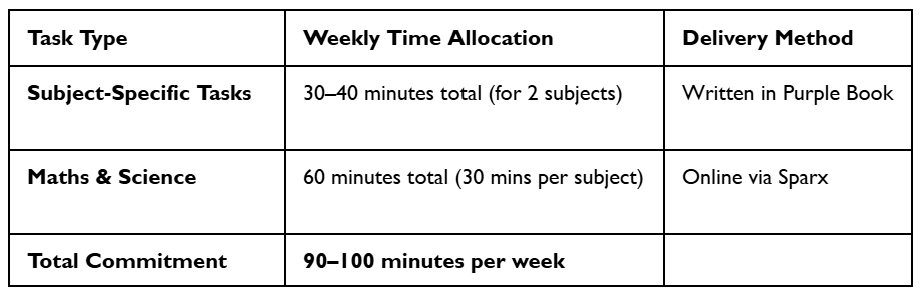
To help manage time effectively, home learning is designed to take roughly 15–20 minutes per weeknight, broken down across the week as follows:
What subjects are covered each week?
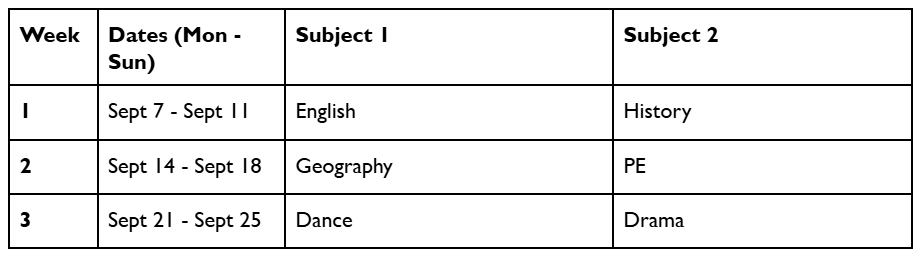
All students receive a half-termly schedule of subject-specific tasks. These tasks directly connect to the work being covered in class and the information in their Knowledge Organisers.
Example Schedule (Autumn Half Term 1):
What are knowledge organisers ?
Each student will be provided with a knowledge organiser that contains the essential knowledge that is required for each subject for each half term. These will also provide you with a clear picture of the topics your child will be studying in school each term.
The knowledge organisers can be found below and will be placed on the google classroom for individual subjects.
The knowledge organisers give you a clear picture of the topics being studied in school each term. We would encourage any family who wants to engage with this at a deeper level at home . Many museums and galleries are free to look around. Many libraries will provide different workshops through the year that may be relevant to the area of study. Documentaries, theatre, films, podcasts all provide opportunities to enrich what is being learnt in the classroom.
If students require a printed version that can be provided if requested.
What is Sparx Maths/Science
Sparx Maths/Science is an online learning platform that enables all students to follow a set of personalised tasks that are designed to improve their retrieval and application skills. When students login they can access key video tutorials that will further support the learning that takes place in lessons. All students will receive their login details through their normal maths/science lessons and be supported to use the platform. All parents will receive regular emails informing you of your child's progress.
You can visit the links below for further information.
Home learning is set each week and students have 1 week to complete the work.
Where do they record their home learning?
All students will be provided with a purple home learning book where they will record all home learning for all subjects.
How should they organise their home learning?
It is important that your child takes the time to organise and present their home learning to the best of their ability as you would for any piece of classwork.
For each piece of home learning your child needs to:
-
Write the date at the top of the page.
-
Write and underline the subject name.
-
Complete home learning for that subject.
-
Write and underline the name of the next subject and so on until completed.
What strategies should they use?
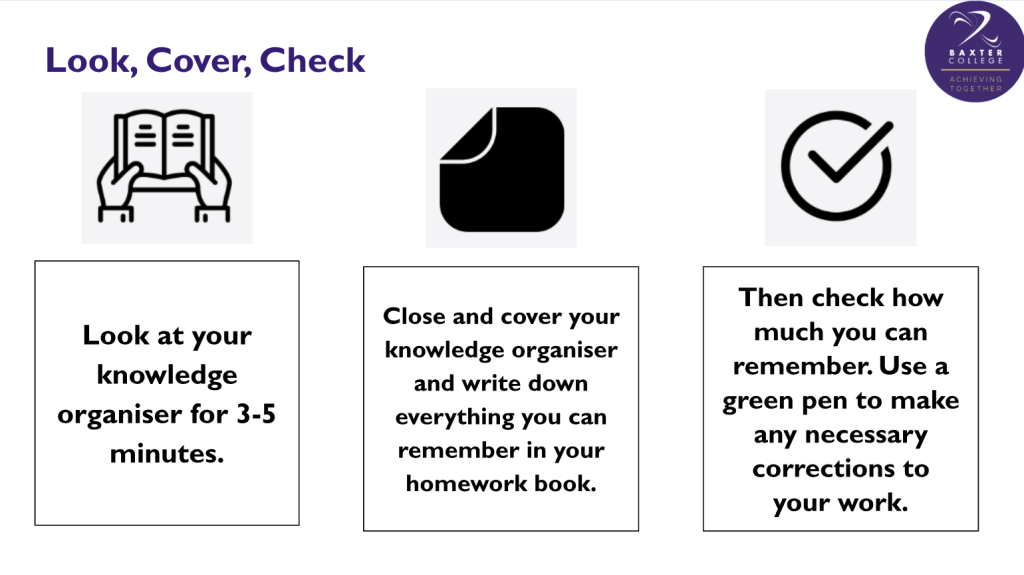
All students will complete their home learning using a strategy known as Look, Cover, Check. This is a very popular revision and retrieval strategy and has been shown to strengthen long term memory and support independent study at home.
All learners will receive guidance on how to use the strategy in form time and this will be recapped regularly across subjects.
How can parents/carers support home learning?
In order to support your child with their home learning there are a number of things you can do;
-
Know their home learning timetable, consider displaying this somewhere visible at home.
-
Try to create a quiet space for your child to work, a tidy desk to allow an opportunity for retrieval.
-
Talk to your child about the knowledge they have retrieved, show interest in their studies.
-
Reward consistent work habits positively. Recognise they have invested time in their home learning.
How will this be monitored
It is compulsory that all students complete their home learning.
This will be checked each week by form tutors house points will be awarded for good effort and completion and if necessary further actions will be taken if the home learning is not completed.
Key Stage 4
To help students succeed at Key Stage 4, our home learning programme is built around independent application. This approach ensures that every assignment is purposeful and manageable, allowing students to practise and solidify their knowledge while building vital revision habits for their GCSEs.
What does this look like?
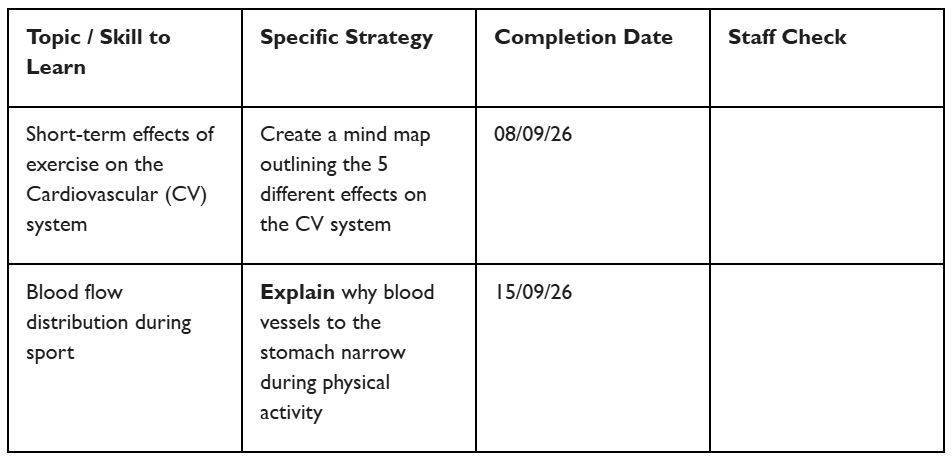
For each subject, pupils will be issued with a set of key learning tasks, specific completion strategies, and deadlines (these will also be uploaded to Google Classroom for reference). These tasks will adapt throughout the year to reflect students' learning needs based on mock and external exam data.
Example of a Student's Task Tracker:
How much time should be spent each evening?
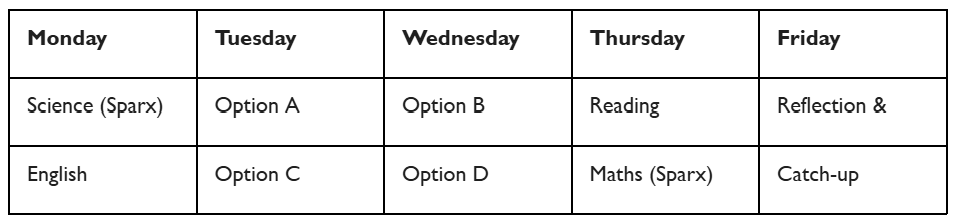
Students in KS4 are expected to spend up to 1 hour each evening completing independent application tasks. This is split into 20–30 minutes per subject across two subjects.
KS4 Evening Timetable
Online Learning: Sparx Maths & Sparx Science
Sparx is an online platform that provides personalised tasks designed to improve retrieval and application skills.
- Support: Students can access key video tutorials to support independent learning. Login details are issued in normal Maths and Science lessons.
- Parents: You will receive regular automated email updates regarding your child's progress.
Important Notice Regarding AI Tools (e.g., ChatGPT, Photomath):
Sparx uses an adaptive algorithm that learns how a student works and tailors the difficulty level specifically to them.
If a student uses AI tools to complete their Sparx homework, the system will incorrectly assume they have mastered advanced concepts. This corrupts the algorithm and artificially drives up the difficulty, making the next set of tasks significantly harder and highly frustrating to complete independently.
If a student is struggling, they must not use AI. Instead, they should speak to their subject teacher or their parents for support so the platform can adapt correctly to their actual learning needs.
Where do students record and complete work?
- Resources: All students have access to their course folders and Google Classroom, where teachers will upload the required application tasks.
- Recording: Tasks must be completed either within specific subject books or submitted via Google Classroom as directed by the teacher.
- Standards: Presentation shows pride. Students must organise and present their home learning to the same high standard expected in classwork.